Predator-Proof Chicken Coop: Mesh, Latches and a Buried Apron
Coopgauge is reader-supported. When you buy through links on this page, we may earn a commission.
Wrap every opening in ½ in hardware cloth, bury it 12 in at the run edge and fit a latch that takes two motions to open. Then close the coop every night. That is the whole job. Where weasels or mink live nearby, use ¼ in mesh on the vents.
- Mesh
- ½ in welded hardware cloth; ¼ in for weasels
- Buried depth
- 12 in or more
- Apron
- bent outward about 6 in
- Latches
- two-step or spring bolt, every door
- Run roof
- mesh or netting, fixed tight
- Night routine
- hens inside, doors locked
Mesh, depth and weasel gap: Kentucky Extension ID-245. Apron: Penn State. Latch type: our build standard.
Most coops fail at one spot, not everywhere at once. A raccoon tests the latch. A fox tests the ground at the fence line. A hawk tests a loose corner of netting. Fix each spot once and the coop stays safe for years.
None of this needs special skill. A roll of hardware cloth, a box of screws with fender washers, a spade and two good latches cover most coops. The work takes a weekend, and it is the best weekend you will spend on the flock.
Kentucky Extension calls the red fox the most common predator of poultry. Raccoons, dogs, coyotes, weasels, snakes, hawks and owls follow. Each one gets in a different way, so the checklist below goes spot by spot.
Weak-spot checklist
| Weak spot | Who gets in | Fix |
|---|---|---|
| Chicken wire on run walls | Raccoon, dog, fox | ½ in welded hardware cloth |
| Open vents and eaves | Raccoon, weasel, snake | Hardware cloth, ¼ in where weasels live |
| Ground at the fence line | Fox, coyote, dog, rat | Bury mesh 12 in or lay a 12 in apron |
| Single hook or knob latch | Raccoon | Two-step latch or spring bolt |
| Open run top | Hawk, owl, climbing raccoon | Mesh roof or tight netting |
| Gaps under doors and floors | Snake, rat, weasel | Close any gap of ¼ in or more |
| Door left open at dusk | All of them | Close and lock every night, or use an automatic door |
Start at the top of the list. Chicken wire keeps hens in, but it is thin and twisted. Kentucky Extension notes that a raccoon will reach through the wire for a bird it cannot fully reach. Welded hardware cloth with ½ in openings stops the paw.
Next, look at every hole in the house. Vents, gaps at the eaves and the space above a door all count. Kentucky Extension says a least weasel can pass through a ¼ in hole, and a snake that fits through a gap of that size can reach chicks. Cover every opening with mesh.
Then check the doors. A hook-and-eye or a twist knob is easy for a raccoon to work open. A spring bolt needs a pull and a slide. A two-step latch needs a lift and a turn. Both are beyond a raccoon, and both are cheap.
Last, look under the house. A raised coop with an open floor frame is fine if the floor itself is solid. A ground-level coop with a dirt floor needs mesh under the floor or a buried apron all the way around, the same as the run.
Fix the run in five steps
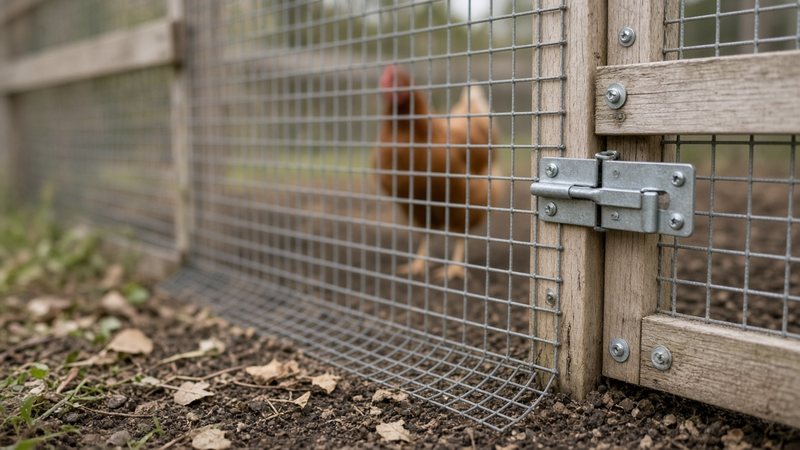
- Strip any chicken wire from the run walls, or cover it with hardware cloth on the outside.
- Dig a trench 12 in deep along the run edge. Penn State bends the bottom 6 in of mesh outward at the base of the trench.
- Fix the mesh to the frame with screws and fender washers. Overlap every seam by one full square.
- Cover the run top with mesh or netting, fixed tight at every edge.
- Fit a two-step latch or spring bolt to every door, including the pop door.
If digging a trench is not practical, lay a flat apron instead. Spread mesh 12 in wide on the ground around the run and pin it down. Grass grows through it in a few weeks. A fox or dog digs at the wall, meets wire and gives up.
Penn State gives both depth figures: bury at least 12 in, and bend the bottom 6 in outward. Kentucky Extension gives the same 12 in for keeping out foxes, coyotes and rats.
Overlap matters more than people expect. A raccoon works at seams and corners with its hands. Screw the mesh every few inches along each frame member, and run a strip of wood over the edge. A stapled seam is the first place a determined animal pulls loose.
Use the same care at the run door. Hang it so it closes against a stop on all sides, with no gap at the bottom. Fit the latch on the outside and a second one on the inside if you ever close yourself in to work. A gap of a few inches under a run door is an open invitation.
By predator
| Predator | Hunts | How it gets in | Main fix |
|---|---|---|---|
| Red fox | Mostly night | Digs, or walks in an open door | Buried apron, door closed |
| Raccoon | Night | Opens latches, reaches through wire | Two-step latches, hardware cloth |
| Dog and coyote | Night and day | Digs, pushes weak fencing | Buried apron, strong frame |
| Weasel and mink | Night | Holes as small as ¼ in | ¼ in mesh on vents |
| Rat snake | Day and night | Gaps of ¼ in or less | Close every small gap |
| Hawk | Day | From above an open run | Mesh or netting over the run |
| Great horned owl | Night | From above, or a roost left outside | Hens inside at night |
Hawks and owls need a different plan from ground animals. A fence does nothing against them. Kentucky Extension suggests covering the run with netting and keeping it tight, since hawks find any loose spot. It notes that orange netting works well, because hawks and owls see orange clearly.
Hawks and owls are federally protected, so the only fixes are covers and shelter. Kentucky Extension also suggests removing perches within 100 yards of the flock, which gives a hawk fewer places to watch from.
Size the netting to the run plus 1 ft on each side, so you can fold it down and fix it to the frame. A 25 × 50 ft net covers a 20 × 40 ft run with room to spare. Pick a small mesh. Add a center post on a wide run. Rain and snow will not pool in the middle.
Raccoons are the cleverest of the ground group. Kentucky Extension notes that two raccoons may work together, one scaring hens to the fence while the other grabs. That is why the fix is mesh a paw cannot pass, not just a taller fence.
Weasels and mink are small. Plan for them anyway. Kentucky Extension describes the least weasel as only 6.5 to 8 in long. That is why the vent mesh drops to ¼ in where they live. Check under doors and at the corners of the floor for gaps of that size, too.
Snakes come for eggs and young chicks more than for grown hens. Kentucky Extension notes that a snake that fits through a gap of ¼ in or less can get in. Collect eggs every day, and close small gaps the same way you would for a weasel.
Habits that close the gaps
| When | Habit | Why |
|---|---|---|
| Every dusk | Count hens in, close and lock every door | Kentucky Extension: roost inside a secured house at night |
| Every evening | Clear spilled feed from the run | Leftover feed draws rats and raccoons |
| Weekly | Collect eggs daily, check latches weekly | Eggs left out draw skunks and snakes |
| Each season | Walk the fence, press each seam and corner | Shrinking wood opens gaps |
The nightly close is the habit that matters most. Kentucky Extension says to have the flock roost in a secured house at night with all doors closed and locked. Hens can be trained to go in at dusk by feeding or watering them inside at that hour.
An automatic door does the close for you on a timer or light sensor. It still pays to look in at dusk now and then. A hen that roosts in a tree misses the door.
Keep the area tidy, too. Kentucky Extension notes that garbage cans and feed left out draw raccoons, which then look for other food nearby. Store feed in a watertight, rodent-proof bin with a tight lid, and leave no feed in the run overnight.
When hens free-range
Free-range time brings its own risks, because no coop can protect a hen in the open yard. Kentucky Extension suggests movable fencing to keep a ranging flock in one area. The fence may be electric or not.
If you use an electric fence, Kentucky Extension says the charge should stun, not kill. A stunned fox learns to stay away. A dead one is soon replaced by another fox. A stun-level fence is also safer for people and pets.
Range the flock in daylight and bring them in well before dusk. Kentucky Extension notes that coyotes hunt mostly at night and bobcats favor the 2 twilight hours of dawn and dusk. A shrub or a small shelter in the range area gives hens cover from hawks. A guard animal is another option Kentucky Extension lists, and your own presence in the yard helps, too.
Common Questions
What size hardware cloth keeps predators out?
Use ½ in welded hardware cloth on the run and every opening. Where weasels or mink live, use ¼ in on vents and small gaps, since Kentucky Extension notes a least weasel fits through a ¼ in hole.
How deep should I bury the fence around a chicken run?
At least 12 in. Penn State adds a 6 in bend outward at the bottom. A flat apron 12 in wide, pinned on the surface, works where you cannot dig.
Will chicken wire keep raccoons out?
No. Chicken wire keeps hens in, but a raccoon can tear it or reach through it. Use welded hardware cloth on any wall a raccoon can reach.
Do I need to cover the top of my chicken run?
Yes, where hawks or owls hunt, and almost everywhere does. Use mesh or netting, fixed tight at every edge. Kentucky Extension notes orange netting is easy for birds of prey to see.
Read next
Sources
- University of Kentucky, ID-245 Predator Management for Small-scale Poultry Enterprises: publications.mgcafe.uky.edu (red fox the most common predator; least weasel through ¼ in; snakes through ¼ in gaps; raccoons reach through wire and work in pairs; orange netting; perches within 100 yards; bury hardware cloth at least 12 in; lock doors at night; no feed left in the run)
- Penn State Extension, Small Scale Poultry Housing (updated 2026): extension.psu.edu (bury 12 in, bend the bottom 6 in outward)
- Hardware cloth mesh, gauge and roll size: maker listing on Amazon, ASIN B01D82U4DE, read 2026-10-12
How we pick and check numbers: How we research.