Chicken Coops and Runs: Size First, Then Type
Coopgauge is reader-supported. When you buy through links on this page, we may earn a commission.
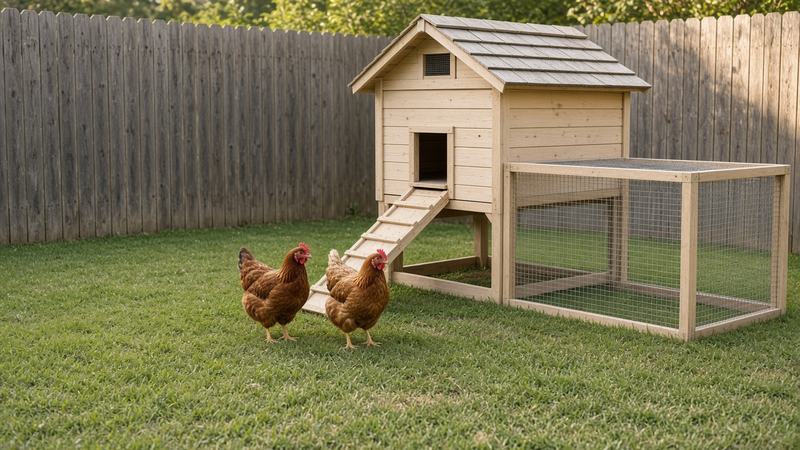
Under 6 standard hens, a raised coop with an attached run is the simple choice. Count 4 sq ft of floor per hen before you pick a type. Bantams need about half that.
Pick a coop by flock size
| Hens | Coop floor | Run | Coop type | Start with |
|---|---|---|---|---|
| 2–5 | 8–20 sq ft | 16–40 sq ft | Raised kit coop with an attached run | Calculator |
| 6–10 | 24–40 sq ft | 48–80 sq ft | Built coop, 4 × 6 ft to 5 × 8 ft | Coop plans |
| 11+ | over 40 sq ft | over 80 sq ft | Walk-in coop or shed conversion | DIY coop |
| Moving flock | same floor rule | the ground under it | Chicken tractor on wheels | Chicken tractor |
The cut points follow the floor math. Five hens need 20 sq ft, which most kit coops cannot honestly hold. Six to ten hens need 24 to 40 sq ft, a size you can build from standard 4 × 8 ft sheets. Past 40 sq ft, a person needs to walk in to clean.
The floor figure is the middle of the 3 to 5 sq ft range from Minnesota Extension. The run figure is the Penn State number for laying hens. For bantams and large breeds, use the calculator.
Two numbers matter more than the coop style. The first is floor area inside the house, where hens sleep and lay. The second is the run, where they spend the daylight hours on most days.
Every other part scales from those two. Roost length is 8 in per standard hen, so six hens need 48 in of bar. Nest boxes run 1 per 4 hens, per Oregon State, so six hens share 2 boxes. A coop that gets the floor right usually has room for both.
If you are unsure between two rows, size up. Hens added later are common, and a coop with spare floor costs little more to build. A crowded coop is hard to fix once it stands in the yard.
Every coop and run page
Sizing
Build
Inside the coop
Protect
Runs
Start with the calculator if you have not counted your hens yet. It gives floor, run, roost and nest box numbers in one step. Then go to plans if you build, or to the gear pages if you buy.
The guides go one layer down. Bedding, roost bars and nest boxes each get a spec card with the measurements. The predator page covers mesh, latches and the buried apron.
Every page gives the numbers first and the reasons after. Each figure links to its source in the list at the bottom. When two sources differ, we show both and say which one our tables use.
Gear
Kit coops list a hen count on the box. Our gear pages convert that claim back into square feet. A coop sold for 4 to 6 hens often has 6 to 7 sq ft inside. That fits 1 or 2 standard hens by the 4 sq ft rule.
That gap is not a reason to skip kits. A small kit suits 2 or 3 bantams well, and it goes up in an afternoon. Just read the floor area, divide by 4 for standard hens, and trust that number over the box.
The two gear pages most keepers need first are coops and doors. Feeders and waterers come next, sized by hen count on their own pages. Each one turns the box claims into numbers you can check against your flock.
Start with the coop that fits your count today, plus one or two more hens. Then add an automatic door so the coop is closed every night, even when you are late home.
If you already have a coop, the same pages still help, because you can measure what you own against the tables and see whether there is room for the two or three hens you would like to add next spring. Most keepers find that the roost bar or the nest box count runs out before the floor does, and both are cheap fixes that take an afternoon with a drill.
Sources
- University of Minnesota Extension, Raising chickens for eggs (reviewed 2025): extension.umn.edu (3 to 5 sq ft indoor space per bird)
- Penn State Extension, Small Scale Poultry Housing (updated 2026): extension.psu.edu (8 sq ft of outside run per laying hen)
- Garvee coop size and hen count: maker listing on Amazon, ASIN B0H83FSTDR, read 2026-10-12
- PawHut main house 6.57 sq ft, 1 to 2 chickens: maker listing on Amazon, ASIN B0C4KDTJY5, read 2026-10-12
- Oregon State University Extension, EC 1644 Backyard chicken coop design (2014, reviewed 2023): extension.oregonstate.edu (1 nest box per 4 birds; roost space per bird)
How we pick and check numbers: How we research.